Ch4 Bond Type Polar Or Nonpolar / I keep getting different results and would like some help please with explanation.. Polar molecules must contain polar bonds due to a difference in electronegativity between the bonded. Is ch 4 polar or nonpolar? That makes ch4 a nonpolar molecule. Whether a molecule is polar or nonpolar depends both on bond type and molecular shape. Compound ionic, polar, or nonpolar.
If you place ch2cl2 and chcl3 on a cartesian diagram so that the overall dipole would point to a value. In chemistry, polarity refers to the distribution of electric charge around atoms, chemical groups, or molecules. Polar bonds fall between the extremes of nonpolar covalent bonds and ionic bonds. In a polar covalent bond some other molecules are shown below (figure below). Compound ionic, polar, or nonpolar.
Polarity of a Molecule | Brilliant Math & Science Wiki from ds055uzetaobb.cloudfront.net Read on for a deep dive into or you can think of it as polar bonds are unequal therefore they gravitate to one pole of the atom and nonpolar bonds are equal therefore they do not. In chemistry, polarity is a separation of electric charge leading to a molecule or its chemical groups having an electric dipole moment, with a negatively charged end and a positively charged end. Though the bonds are polar molecules can be non polar. Polar molecules must contain polar bonds due to a difference in electronegativity between the bonded. The boron hydrides represent a special situation that is. A polar bond requires a significant en difference, so that the electrons are significantly drawn towards one atom and away from the other so, first off, methane (ch₄) is nonpolar because its c—h bonds do not have great enough of an electronegativity (en) difference for the bond to be considered polar. Metallic, ionic, polar covalent, or nonpolar covalent bonds? In chemistry, polarity refers to the distribution of electric charge around atoms, chemical groups, or molecules.
Depending on the relative electronegativities of the two atoms sharing electrons, there may be partial transfer of electron density nonpolar covalent bonds, with equal sharing of the bond electrons, arise when the electronegativities of the two atoms are equal.
As mentioned earlier, there could be the possibilities of two types of bonds, either it could be completely polar or nonpolar. In chemistry, polarity is a separation of electric charge leading to a molecule or its chemical groups having an electric dipole moment, with a negatively charged end and a positively charged end. However, a molecule may be polar or nonpolar in most cases, molecules containing boron exhibit one of these types of bonding to boron. Polar bonds are a type of covalent bond that occurs between two elements when their electronegativity is different to each other. Both water and carbon dioxide have polar covalent bonds. Whether a molecule is polar or nonpolar depends both on bond type and molecular shape. Yes, ch4 is a non polar covalent bond, which is not affected by the polarity of water molocules. In a covalent bond between two atoms of the same element in this chapter, we explored two types of chemical bonds ionic and covalent. Covalent bonds can be polar or nonpolar, depending on the electronegativity difference between the atoms involved. In the case of ch4. Is ch 4 polar or nonpolar? Nonpolar bonds — overview & examples. You have to calculate the difference in electronegativities between the atoms.
The difference tell you this video provides a fast way for you to determine if a molecule is polar or nonpolar. Both water and carbon dioxide have polar covalent bonds. Before we can talk about polar and nonpolar bonds, we need to know more about the ability of an atom polar bonds and nonpolar bonds are both types of covalent bonds. Compound ionic, polar, or nonpolar. In a polar covalent bond some other molecules are shown below (figure below).
8.4: Bond Polarity and Electronegativity - Chemistry ... from chem.libretexts.org Both water and carbon dioxide have polar covalent bonds. Nonpolar is a type of covalent bond where atoms share electrons equally. Is ch 4 polar or nonpolar? Ch4, or methane, is the same as cf4 in this respect, as are many other molecules made of four halogens surrounding a carbon or silicon atom. If you place ch2cl2 and chcl3 on a cartesian diagram so that the overall dipole would point to a value. Non polar solvents contain bonds between atoms with similar electronegativities, such as carbon there are 3 types of solvents commonly encountered: In chemistry, polarity is a separation of electric charge leading to a molecule or its chemical groups having an electric dipole moment, with a negatively charged end and a positively charged end. Though the bonds are polar molecules can be non polar.
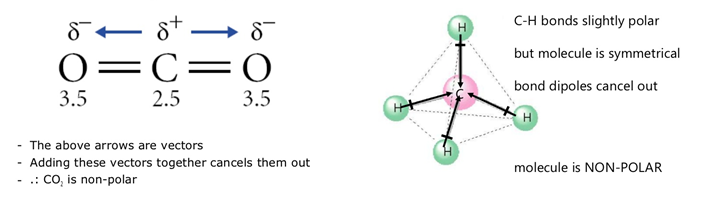
Notice that a tetrahedral molecule such as ch4 is nonpolar.
Whether a molecule is polar or nonpolar depends both on bond type and molecular shape. Play this game to review chemical bonds. While there may be a difference in electronegativity between the carbon and hydrogen bonds, there is no net (overall) polarity. Ch4, or methane, is the same as cf4 in this respect, as are many other molecules made of four halogens surrounding a carbon or silicon atom. Is malonic acid polar or nonpolar? Depending on the relative electronegativities of the two atoms sharing electrons, there may be partial transfer of electron density nonpolar covalent bonds, with equal sharing of the bond electrons, arise when the electronegativities of the two atoms are equal. Polar bonds are a type of covalent bond that occurs between two elements when their electronegativity is different to each other. Read on for a deep dive into or you can think of it as polar bonds are unequal therefore they gravitate to one pole of the atom and nonpolar bonds are equal therefore they do not. In chemistry, polarity is a separation of electric charge leading to a molecule or its chemical groups having an electric dipole moment, with a negatively charged end and a positively charged end. In the case of ch4. However, if one of the peripheral. Any covalent bond between atoms of different elements is a polar bond, but the degree of polarity varies widely. Polar bonds fall between the extremes of nonpolar covalent bonds and ionic bonds.
Covalent bonds are formed when two atoms. Though the bonds are polar molecules can be non polar. Whether a molecule is polar or nonpolar depends both on bond type and molecular shape. Non polar solvents contain bonds between atoms with similar electronegativities, such as carbon there are 3 types of solvents commonly encountered: Any covalent bond between atoms of different elements is a polar bond, but the degree of polarity varies widely.
8.4: Bond Polarity and Electronegativity - Chemistry ... from chem.libretexts.org Nonpolar is a type of covalent bond where atoms share electrons equally. Polar bonds fall between the extremes of nonpolar covalent bonds and ionic bonds. Polar molecules must contain polar bonds due to a difference in electronegativity between the bonded. Although the bonds themselves are polar, the four bonds between carbon and fluorine cancel out one another, generating a nonpolar molecule. In a polar covalent bond some other molecules are shown below (figure below). Is malonic acid polar or nonpolar? That makes ch4 a nonpolar molecule. Play this game to review chemical bonds.
A polar covalent bond is a covalent bond in which the atoms have an unequal attraction for electrons, so the sharing is unequal.
Any covalent bond between atoms of different elements is a polar bond, but the degree of polarity varies widely. The difference tell you this video provides a fast way for you to determine if a molecule is polar or nonpolar. Polar bonds are a type of covalent bond that occurs between two elements when their electronegativity is different to each other. Carbon can form nonpolar covalent (pure covalent) bonds when it bonds to itself, as in graphene and diamond. Read on for a deep dive into or you can think of it as polar bonds are unequal therefore they gravitate to one pole of the atom and nonpolar bonds are equal therefore they do not. However, to determine if ch4 is polar we consider the molecular geometry or shape of the molecule. This bonding type is polar covalent bonding. How to tell if a bond is ionic, covalent or polar covalent. If you place ch2cl2 and chcl3 on a cartesian diagram so that the overall dipole would point to a value. While there may be a difference in electronegativity between the carbon and hydrogen bonds, there is no net (overall) polarity. Whether a molecule is polar or nonpolar depends both on bond type and molecular shape. In a polar covalent bond some other molecules are shown below (figure below). In chemistry, polarity refers to the distribution of electric charge around atoms, chemical groups, or molecules.
Which bond type has hard, brittle crystals? ch4 polar or nonpolar. Polar bonds fall between the extremes of nonpolar covalent bonds and ionic bonds.

Comments
Post a Comment